Blog

  • Top Rated Home Gadgets to Improve Comfort and Security

    Top Rated Home Gadgets to Improve Comfort and Security

    Creating the perfect living environment starts with smart tools. This guide highlights top-tier home gadgets that enhance comfort and protect your space. Additionally, it explores ideal picks for those working remotely. So, even if you have a laptop and monitor setup, these selections can elevate your day. Therefore, this blog will empower readers in work from home jobs that provide equipment to upgrade their worlds. First, we’ll explore comfort-enhancing devices. Then, we’ll cover security-focused picks.

    1. Smart Thermostat for Year‑Round Comfort 

    A smart thermostat is a must-have home gadgets for every home. It adjusts temperatures intelligently. Moreover, it learns your routine. For instance, it lowers settings while you sleep. Then, it warms your rooms just before you wake. 

    Therefore, you stay efficient and cozy. It works with most HVAC systems. Also, you can control it from your smartphone. Even if you work remotely with a laptop and monitor setup, you can adjust comfort from your desk. Furthermore, voice control lets you speak commands. Additionally, it tracks energy usage in real time. Thus, you save on monthly utility bills. Meanwhile, it alerts if temperatures rise too fast. That feature is ideal for hot summers. 

    Consequently, you avoid overcooling or breakdowns. Many smart thermostats integrate with home security platforms to make it convenient. They boost safety and comfort together. Finally, they often include geofencing. Therefore, they save energy when no one’s home but ensure warmth on return.

    2. Air Purifier with HEPA Filter

    Clean air is underrated, but with the right home gadgets, it’s a game-changer. A HEPA purifier clears dust, pollen, and pet fur. Many include smart sensors that adjust fan speed automatically. That means you’re breathing pure air without realizing it. Want to check the filter status? Do it from your phone while working on your laptop and monitor setup. Some purifiers even zap germs with UV-C light. 

    Picture fresh, quiet air that helps you think, sleep, and relax, without distraction. If you happen to be doing work from home jobs that provide equipment, this makes your workspace feel like a peaceful retreat.

    3. Smart Lighting For Better Productivity 

    Lighting is a powerful tool to enlighten your home office. It shapes your energy, mood, and even productivity. With smart LED bulbs, you pick colors, dimming, and schedules. You can wake up gently with warm tones or create a movie-night vibe with cinematic hues. If you receive an unexpected package late at night, your lights can flip on automatically, adding both convenience and safety. Plus, they can easily be connected to voice assistants. 

    Say “movie time,” and your space transforms. Even if you’re deep into a laptop and monitor setup, a simple voice prompt changes your ambiance instantly. Not only is this fun, but it also helps deter would-be intruders if you’re away. This allows you to blend practicality and personality for a smart setup.

    4. Wi‑Fi Security Cameras

    Gone are the days of wondering what’s happening at home. A Wi‑Fi camera offers clear video, night vision, and motion alerts. Whether you’re on your laptop and monitor setup or out running errands, you get instant updates. Some cameras let you chat with whoever is on the other side, perfect for greeting deliveries or telling the mail carrier, “Thanks!” 

    You can sync lights or even have the camera flash a warning if it senses movement. And with cloud storage, you keep a safety record for peace of mind. If you’re in work from home jobs that provide equipment, this brings a comforting layer of protection during long workdays.

    5. Smart Door Locks

    Losing your keys all the time? We have a solution for you. A smart lock lets you use codes, your phone, or even your voice. You can get an instant alert when someone arrives, and set up temporary codes for housemates or guests. It smoothly integrates with assistants, so “lock the door” is literally a voice command away. 

    Even during a focused laptop and monitor setup session, you’re in control. Plus, the system logs entries and sends alerts if someone tries forced entry. For those in work from home jobs that provide equipment, it’s a sleek upgrade that blends security and convenience, no key fumbling required.

    6. Robot Vacuums

    Imagine a tiny robot that knows your home better than you do. That’s what a robot vacuum is. There are so many smart models on the market. It maps, avoids obstacles, recharges, and resumes all on its own. While you’re working at your laptop and monitor setup, it hums away, leaving the floors dust-free. 

    And thanks to app control or voice support, you tell it what to do without getting up. Many even mop! If you’re in work from home jobs that provide equipment, it frees up precious time so you can focus or finally relax without worrying about chores.

    7. Heated Foot Rest

    Cold feet? Meet your new best friend. A heated foot rest warms your toes and improves blood flow as you work long hours on that laptop and monitor setup. Adjustable heat settings mean perfect warmth, and some include gentle massages. 

    It’s compact and hides neatly under your desk, but brings a touch of luxury you didn’t know you needed. And if your role includes work from home jobs that provide equipment, this little comfort boost can make your home office feel premium.

    8. Smart Smoke and CO Detector

    Smoke and CO detectors can feel invisible until they save lives. A smart version sends alerts to your phone, so you’re always in the loop. In emergencies, lights flash and alarms scream. And if you’re working at your laptop and monitor setup, you’ll still get a notification. 

    These models sync across your home, so one alert triggers them all. That means comprehensive safety, even when you’re in the zone. They keep logs, self-test, and switch to battery backup during outages. For anyone doing work from home jobs that provide equipment, this isn’t just smart, it’s essential.

    9. Smart Plug + Energy Monitor

    Smart plugs work like energy detectives for a home. Control your coffee maker, desk lamp, or heater remotely. Watch and track usage stats in real time, even if you are working remotely or doing wfh. 

    Is that coffee mug warming unnecessarily? Turn it off on your phone. Got automation? Schedule it. Use voice commands during your laptop and monitor setup sessions. You’ll even get alerts if something runs too long. 

    If your work from home jobs that provide equipment include high-power gear, tracking energy helps avoid bill shock. Plus, pairing them with other gadgets offers smart routines, like shutting everything down at bedtime.

    home gadgets

    Final Thoughts

    We hope these gadgets help you in deciding what you need for your home. All of these nine wonderful home gadgets bring comfort, security, and a touch of magic to your everyday life. From thermostats that learn your habits to robot vacuums that keep things sparkling, each gadget helps your home feel like yours. Items like smart cameras, door locks, and smoke detectors protect you without you even thinking. 

    Meanwhile, cozy comforts, a heated foot rest, and purifiers create a workspace you look forward to. Even that laptop and monitor setup gets that extra spark. If you’re diving into work from home jobs that provide equipment, these picks make your home office both functional and delightful. So pick one, two, or all and watch your space transform into your sanctuary.

    Subscribe to What Works Next today and join a community dedicated to transforming the way we work. Working smarter starts here!


  • Is the 4-Day Workweek Best for the Future of Remote Work?

    Is the 4-Day Workweek Best for the Future of Remote Work?

    4-Day Workweek

    A 4-day workweek is a game-changer for many, especially for those who want to have a work-life balance. Imagine logging off on a Thursday evening and still earning a full week’s pay (by completing your designated work hours, obviously). 

    For a growing number of companies and employees, this is no longer a fantasy but a budding reality. The concept of a 4-day workweek has shifted from a fringe idea to a mainstream discussion as people reimagine how we work in the post-pandemic world. 

    With remote work becoming ingrained in many industries, some wonder if shortening the workweek is the natural next step in the future of remote work or not? Researchers and business leaders alike are paying attention to the rising demands of employees. There is mounting evidence that working fewer days while completing your hours, without reducing pay, can maintain or even boost productivity while improving employee well-being and work-life balance

    However, the million-dollar question also arises: is it truly a game-changer, or just another workplace trend? Let’s unwrap the concept more to understand the truth. 

    Pros of the 4-Day Workweek

    Many experts argue that a 4-day workweek can be a win-win for both employees and employers. And one of the biggest reported benefits among the employers is higher productivity.

    There’s something counterintuitive yet compelling about getting more done by working less. For example, when Microsoft trialed a four-day week in Japan, they saw a staggering 40% boost in productivity. 

    Global trials coordinated by the nonprofit 4 Day Week Global in 2022 similarly found that companies maintained 100% of their output even with a day less of work. By cutting out wasted time, fewer pointless meetings, and less distraction, employees often accomplish the same amount in four days that they used to in five. And this is huge and every employee’s dream to achieve. And being a remote worker, I would always vouch for flexible working dynamics. 

    In many cases, a three-day weekend every week can reduce burnout and improve overall mental health. It’s not surprising that in global surveys, the vast majority of workers say they would prefer a shorter week. 

    One poll found that 97% of employees would like a four-day week to become a permanent option at their workplace. 

    Adopting a shorter week may also help companies attract and retain talent. Burnout has been a major driver of the “Great Resignation,” as many professionals re-evaluate their careers and priorities. Offering a 4-day workweek is one way employers can stand out in a competitive job market. 

    Cons and Challenges

    Despite the excitement, unlike any other trend, the 4-day workweek is not without its challenges. 

    One big concern is that it may not work in every industry. It’s easy to shorten the week for many office jobs, but much harder for sectors like healthcare, manufacturing, or customer service that require around-the-clock coverage. Hospital staff, for instance, can’t all take Fridays off without replacements. Critics note that if employers must hire additional workers or pay overtime to cover that extra day off, it could wipe out any benefits of the change.

    Another challenge is that a shorter week isn’t universally appealing. Some workers, especially hourly employees, would rather log more hours for extra pay than take a day off. And if a company simply compresses 40 hours into four longer days, any work-life balance gains might evaporate because employees end up just as tired. 

    Many four-day experiments have involved small, white-collar firms that were already inclined to try flexible work arrangements. It remains to be seen if the results can be replicated in larger organizations or roles with less flexibility. There could also be a honeymoon effect where productivity might jump in the short run when everyone is eager to prove the concept, but perhaps those gains level off after a year or two.

    Finally, company culture plays a major role. A 4-day workweek by itself won’t fix deeper issues in a toxic workplace. As one pioneer of the model put it, it “doesn’t work if there is no trust” between management and employees. Successful trials require rethinking workflows and measuring performance by results, not just hours. Without that groundwork, some four-day experiments have faltered or been rolled back when they didn’t yield the expected outcomes.

    Current Experiments and Global Policies

    United Kingdom:

    Perhaps the most high-profile trial took place in the UK in 2022, where over 60 companies shifted to a four-day schedule for six months with no pay cut. Productivity and revenue were largely maintained, and employees experienced less stress and improved well-being. 

    At the pilot’s end, over 90% of the companies chose to continue the four-day week, with 18 of them making it permanent. Observers called it a breakthrough in modern work culture.

    Importantly, the UK pilot showed that even in a variety of sectors, the four-day model could work well, though it’s worth noting most participants were smaller businesses and willing volunteers.

    Iceland: 

    Before these newer trials, Iceland conducted one of the earliest large-scale experiments in shortening the workweek. Between 2015 and 2019, Reykjavík’s city council and the national government trialed reducing the workweek from 40 hours to about 35 hours with no pay cut. 

    About 2,500 workers (over 1% of Iceland’s working population) participated across various jobs, from offices to hospitals. Researchers deemed it an “overwhelming success.” Productivity stayed the same or even improved, and workers’ well-being saw a significant boost. 

    Employees reported lower stress and burnout. Following the trial, Icelandic unions negotiated to make shorter hours permanent for many. Today, close to 90% of Iceland’s workers have the option to work fewer hours than the traditional 40.

    Spain: 

    Spain is another country actively exploring the four-day week. The Spanish government launched a pilot program in 2023 to encourage a shorter week. It allocated €10 million to help small and medium-sized firms cut work hours by around 10% (from 40 hours to 36) without cutting pay.

    Separately, the city of Valencia ran an experiment by giving everyone four long weekends in a row. Public holidays were placed on four consecutive Mondays in Spring 2023. Early results from Valencia indicated that people felt happier and less tired, and air quality improved thanks to less traffic. Spain’s national government will evaluate these results and could consider broader changes if outcomes are favorable.

    Belgium: 

    Belgium became the first country in the European Union to legally allow a four-day workweek in 2022. However, the law requires compressing the usual 38 – 40 hours into four longer days, and fewer than 1% of Belgian employees have opted to take this deal so far.

    United States: 

    In the U.S., there isn’t any official policy for a 4-day workweek, but interest is growing. A handful of forward-thinking companies have embraced the idea. 

    Kickstarter, for example, ran a successful trial, and the tech firm Buffer permanently adopted a four-day schedule after finding it effective. A few lawmakers have even floated the concept. A few states have even debated making 32 hours the new standard, and in Congress, Rep. 

    Mark Takano introduced a bill to cut the national standard from 40 hours to 32. None of these proposals have passed yet, but the fact that they’re being seriously considered shows how mainstream the idea is becoming in conversations about the future of remote work.

    Final Thoughts: Where We’re Headed?

    So, is the four-day week just a fad, or is it truly the future of remote work? Based on the trends and trials so far, the momentum is real. The pandemic fundamentally shifted how we view work, shattering old assumptions about office norms and productivity. Remote and hybrid work gave people a taste of flexibility, and the 4-day workweek is an extension of that desire for a more balanced life. 

    Early adopters have shown that it’s possible to work smarter rather than longer to get the job done in fewer hours and still reap equal or greater results. Employees, unsurprisingly, are enthusiastic about the prospect that many say they’d choose a shorter week over a pay raise, if given the option.

    In the coming years, more companies will no doubt experiment with condensed schedules. Some will find it transformative while others may decide it’s not for them. 

    But the genie is out of the bottle! The idea of the 4-day workweek has moved from a radical fringe proposal to a serious consideration for improving modern work. It challenges the notion that “full-time” must mean 40+ hours chained to a desk or constantly being online. 

    As we forge ahead into the future of remote work, the four-day week is poised to be a key part of the discussion. If done thoughtfully, it could help create a future of work that is both productive and humane, where success is measured in results, and people have the time to enjoy the lives they’re working for.

    Subscribe to What Works Next today and join a community dedicated to transforming the way we work. Working smarter starts here!

  • 10 Best Ways to Recover from Burnout

    10 Best Ways to Recover from Burnout

    If you’re feeling utterly drained by work, exhausted, cynical, and far less effective than you used to be, you may be experiencing burnout. Most of us have experienced the same at least once in our lifetime. 

    However, the good news is that it’s possible to recover from burnout, even if it feels overwhelming right now. Burnout feels like a stuck in state, a feeling of chronic stress overload that can leave you emotionally and physically exhausted. Doesn’t matter if you are working in the field or as a remote worker, anyone can feel work burnout. 

    The World Health Organization defines burnout as a workplace syndrome characterized by exhaustion, increased mental distance or cynicism about work, and reduced professional efficacy. 

    It’s alarmingly common! Recent surveys show that a majority of employees have felt burned out, and about 72% say burnout negatively affected their job performance. In other words, burnout doesn’t lead to increased productivity. It rather hurts your productivity and well-being. 

    What is Burnout?

    Burnout is a workplace phenomenon that has gained more attention in recent years (though it’s not entirely new – the term has been around since the 1970s). The fatigue and work burnout have been there all along the centuries.

    It’s not simply being tired or having a stressful day. Burnout usually develops after prolonged work stress or overwork that hasn’t been successfully managed. 

    Signs of burnout include: 

    • Feeling exhausted all the time (no matter how much sleep you get)
    • Becoming negative or cynical about your job or colleagues, and a noticeable drop in your performance or productivity. 
    • You might feel detached, unmotivated, or even hopeless – like you’re running on empty.

    Burnout was officially recognized by the WHO in 2019 as an occupational syndrome, which validated what many workers already knew: this is a real, serious condition, not a personal weakness. It affects not only employees’ health, but also businesses and economies (burned-out employees are frequently unwell, less efficient, and more likely to quit). 

    If you’re experiencing these symptoms, know that you’re not alone and that you can recover from burnout with the right steps. Before jumping into recovery, it’s important to acknowledge that you are burned out and that something needs to change – this self-awareness is the first step toward healing. 

    How to deal with it (10 Strategies to Recover from Burnout)

    Recovering from burnout requires a combination of lifestyle changes and professional support. It’s about restoring your energy, regaining balance, and addressing the factors that led to burnout in the first place. 

    Here are the 10 best ways to recover from burnout, blending caring for your personal well-being with proactive steps in your work life. These strategies range from simple self-care practices to bigger changes in how you approach work. Try the tips that fit your situation, and remember that recovering from burnout is a gradual process, so be patient and kind to yourself as you work through it. 

    With time, these strategies can help you feel better, achieve a healthier work-life balance, and even enjoy increased productivity once you’re recharged.

    1. Recognize Burnout and Take It Seriously

    The first step to recover from burnout is acknowledging that you’re burnt out in the first place. It sounds obvious, but many people try to ignore the signs or blame themselves for not “handling it.” Recognize that burnout is a real condition – it doesn’t mean you’re lazy or weak. 

    It means you’ve been under chronic stress for too long. Pay attention to your feelings and symptoms: Are you constantly exhausted, no matter how much you rest? Do you dread work or feel cynical about projects that used to excite you? Has your performance or concentration dropped? These can all be burnout indicators. 

    Admitting you’re burned out can be tough (especially if you pride yourself on coping with anything), but it’s crucial. Permit yourself to say, “I’m not okay, and I need a change.” This mindset shift lets you seek solutions rather than pushing yourself to the breaking point. Remember, recover from burnout isn’t possible until you accept that the way you’ve been working isn’t sustainable. This step is an act of self-compassion and an understanding that you’re human, and something needs to change for the sake of your health.

    2. Take Time Off to Rest and Recharge

    One of the best ways to recover from burnout is to give yourself a real break. Continuous overwork without sufficient rest is often what causes burnout, so the antidote is genuine relaxation. If possible, take some time off work. Use those vacation days, or even a short leave of absence if you’re severely burned out. 

    Stepping away from work stressors, even briefly, can start to replenish your energy and perspective. During this time, focus on quality rest. Aim for plenty of sleep (7–9 hours per night if you can) and engage in low-key, restorative activities. That might mean sleeping in, taking naps, or just spending a day doing nothing without guilt. 

    Don’t underestimate the power of downtime for your brain and body. If a long vacation isn’t feasible, try to inject micro-breaks into your day like short walks, a relaxing lunch away from your desk, or a tech-free evening. 

    Studies show that taking regular breaks during the workday can prevent fatigue and help maintain productivity. It might feel counterintuitive, but resting more can lead to increased productivity in the long run, because you return to work recharged rather than depleted. Use weekends and evenings truly for unwinding: disconnect from email, enjoy nature, or lounge with a good book. 

    At first, you might feel anxious stepping away from work obligations, but remind yourself that recovery is an investment. By recharging now, you’ll be able to perform better later. Rest is not a luxury; it’s a necessity for healing burnout.

    3. Set Boundaries and Rebuild Work-Life Balance

    Burnout often goes hand-in-hand with a blurry line between work and personal life. When work spills into all hours of your day, or you feel you can never switch off, it’s a recipe for exhaustion. To recover from burnout, start setting healthy boundaries and reclaiming your time off. This could mean establishing a firm end to your workday (and sticking to it!), not checking work email on weekends, or communicating with your team when you’re not available. 

    Talk to your boss or colleagues if needed. You can frame it positively, like “I’ll be able to focus better and achieve increased productivity during work hours if I also have uninterrupted off-duty time to recharge.” 

    Many enlightened workplaces understand the importance of work-life balance and are willing to support these boundaries. Offering work-life balance perks (like flexible schedules or mental health days) is known to reduce burnout and improve employee retention. So, don’t be afraid to prioritize your well-being. Say “no” to extra tasks when your plate is full – it’s okay to be assertive about your limits. 

    Rebuilding a work-life balance might involve cutting back on overtime, delegating when possible, or simply making a rule to unplug after a certain hour. By creating these boundaries, you give yourself space to rest, enjoy life, and come back to work with a clearer mind. Over time, this balance will guard you against future burnout and keep your performance more consistent (and even boosted, since a rested mind is more creative and productive).

    4. Lean on Your Support Network

    You don’t have to recover from burnout alone. Isolation can make burnout worse, while sharing your work struggles with someone you trust can provide relief and perspective. Reach out to your support network – this could be your partner, close friends, family members, or even supportive coworkers. 

    Let them know what you’re going through. Simply expressing your feelings to a sympathetic ear can lighten the emotional load (there’s a saying that “a problem shared is a problem halved”). Your loved ones might also help in practical ways, if possible, and maybe by taking on some of your chores or responsibilities for a while, or just encouraging you to relax. 

    At work (remote or in-person), consider confiding in a trusted colleague or mentor about your burnout. They may offer advice or help you speak to management about adjustments. Sometimes, just knowing that someone at work understands your situation can reduce the pressure you feel. If you’re comfortable, tell people what you need. 

    Whether it’s asking your partner for a bit more help around the house, or requesting your team at work to refrain from contacting you after hours. People can’t read your mind, so being honest about needing support is important. Don’t let pride keep you from leaning on others. Everyone needs help at times. Social connection is a powerful antidote to stress – a fun afternoon with friends or a heart-to-heart chat with someone who cares can remind you that you’re valued for more than just your job. 

    Feeling supported will reinforce that you’re not alone in this, making it easier to recover. Plus, positive relationships and a strong support system are linked to better mental health and resilience, which will help you recover from burnout more quickly and sustain a healthier balance going forward.

    5. Seek Professional Help if Needed

    Burnout can take a serious toll on your mental and physical health. Sometimes, the fastest way to recover from burnout is with the guidance of a professional therapist or counselor. There’s absolutely no shame in seeking help. Therapists are trained to help people navigate stress, set boundaries, and cope with the overwhelming feelings that come with burnout. 

    In fact, recovering from burnout is often much easier with the help of a therapist. A mental health professional can provide a safe space to vent, help you develop coping strategies, and hold you accountable as you make changes. They can also screen for related issues; burnout can sometimes overlap with depression or anxiety, and a therapist can determine if additional treatment (like medication or more specialized therapy) is needed in your case. 

    If you have access, consider using any Employee Assistance Programs (EAP) your workplace might offer – these often include counseling services. Additionally, a therapist might recommend support groups where you can connect with others recovering from similar work stress, knowing others get it can be validating. 

    Extreme fatigue or stress can sometimes contribute to health issues, so ruling out any physical problems (such as thyroid issues or vitamin deficiencies) is wise. A healthcare provider can also guide you on medical leave if your work burnout is severe. Remember, asking for professional help is a sign of strength and self-awareness, not weakness. 

    Just as you’d see a doctor for a persistent physical ailment, seeing a therapist or doctor for burnout is an investment in your health. With their support, you can create a structured recovery plan and gain tools that will not only help you recover from burnout now but also build resilience for the future.

    6. Practice Mindfulness and Stress-Reduction Techniques

    Burnout pushes your mind and body into a constant state of tension. To counter this, it helps to cultivate habits that promote calm and mindfulness. Practices like meditation, deep breathing exercises, yoga, or progressive muscle relaxation can significantly reduce stress and help you recover from burnout. The idea isn’t to magically solve all your work problems, but to change how your body reacts to work stress. For example, taking even 5-10 minutes a day to do a simple breathing exercise or a quick mindfulness meditation can lower your cortisol levels and bring a sense of peace into your routine. 

    Over time, these practices build your resilience to stress. Try different stress-management techniques to see what resonates with you. Some people find guided meditation or apps helpful, while others might prefer a quiet walk in nature as a form of mindfulness. Even engaging in prayer or listening to calming music can be therapeutic. 

    Invest in mind-body activities like yoga or tai chi combine gentle exercise with mindfulness, giving you physical relaxation and mental calm at once. Remember that managing stress is a skill. The more you practice these techniques, the more effective they become. By incorporating mindfulness into your daily routine, you’ll find you can quiet your racing thoughts and calm your nervous system more easily. 

    This not only helps you feel better in the moment, but also prevents stress from accumulating. Reducing your overall stress through these techniques is a key component as you recover from burnout, and it will help you maintain your well-being and increased productivity when you return fully to your work routine.

    7. Prioritize Physical Health: Exercise and Nutrition

    Your mind and body are deeply connected, especially when it comes to stress. Long periods of burnout often leave people in poor physical shape.  Perhaps you’ve been too tired to exercise or grab unhealthy convenience foods because you’re overworked. 

    Part of recovering from burnout is nurturing your body back to health, which in turn improves your mood and energy. Start with gentle exercise: Physical activity is a proven stress reliever and mood booster. You don’t have to jump into intense workouts if you’re exhausted. Even a daily walk around the block or some light stretching can release endorphins and help you sleep better. 

    Next, look at your nutrition. When we’re stressed or burnt out, we often crave sugary or fatty “comfort” foods or rely on caffeine to get through the day. But these habits can exacerbate fatigue and mood swings. Try to incorporate a balanced, wholesome diet such as plenty of fruits, vegetables, lean proteins, whole grains, and staying hydrated. 

    Eating a healthy diet can stabilize your energy levels and even boost your mood. Simple changes like not skipping meals, cutting down on excess sugar, and avoiding too much alcohol (which can disrupt sleep and mood) will make a difference. Also, prioritize sleep as part of your physical health regimen. Good “sleep hygiene” (like maintaining a consistent bedtime, creating a relaxing pre-sleep routine, and keeping your bedroom dark and cool) is crucial. Aim for those 7-9 hours of sleep nightly; your brain does a lot of recovery work during sleep. Treat these lifestyle changes not as a temporary “fix,” but as new healthy habits. 

    8. Rediscover Enjoyable Activities and Hobbies

    Burnout can make life feel joyless, especially when you’re so exhausted from work, you stop doing the things you used to love. A powerful way to recover from burnout is to intentionally bring back activities that make you happy outside of work. 

    Think about hobbies or pastimes that you’ve neglected, like reading novels, gardening, painting, playing music, cooking, hiking, playing sports, video games, and crafting. Whatever used to light you up. Make time for these non-work activities, even if it’s just a little bit each week. 

    At first, you might have to schedule fun into your calendar (ironically, burnout can be so bad that “having fun” feels hard or like just another task). But start small steps, perhaps commit to 30 minutes of a hobby on a Saturday, or one evening dedicated to something you enjoy. 

    Engaging in hobbies provides a mental escape from work stress and reminds you that you are more than your job. It can restore your creativity and sense of play. For example, if you love nature, a quiet walk in the park or a weekend hike can be incredibly refreshing. If you used to have a passion for music, maybe dust off that guitar or create a playlist of songs that uplift you. 

    9. Cultivate Self-Compassion and Let Go of Perfectionism

    People who burn out are often the ones who push themselves the hardest, such as high achievers, perfectionists, or those with a strong sense of responsibility. O

    One essential way to recover from burnout is to be kinder to yourself. Cultivate self-compassion! Treat yourself with the same understanding and care that you’d offer to a good friend who was struggling. Acknowledge that you are going through a difficult time and that it’s okay to prioritize your own needs. This might involve letting go of perfectionist tendencies. If you’ve been holding yourself to impossibly high standards at work or home, it’s time to dial back the pressure.

    When you start feeling guilty for taking a break or not being perfect, gently remind yourself that taking care of yourself will ultimately enable you to perform better in the long run. It might help to practice positive self-talk or affirmations, like “I deserve rest,” or “Everyone has limits, and it’s okay for me to recharge.” 

    Duke, a psychotherapist interviewed by the Cleveland Clinic, suggests telling yourself: “Clearly, right now, the stress in my life is exceeding my coping capacity… everybody goes through hard times. How can I take care of myself now?”

    10. Reevaluate Your Goals and Work Expectations

    Finally, as your energy and clarity start to return, take time to reevaluate your priorities, goals, and the way you approach work. Burnout is often a signal that something fundamental needs to change in your professional life. Maybe your workload is consistently too high, or you’re in a role that doesn’t suit you, or you’ve been chasing unattainable expectations.  

    For instance, if family or health is a top priority, but you’ve been working 12-hour days, that misalignment will cause chronic stress. Consider discussing your workload or role with your employer, and discuss if responsibilities can be adjusted or shared. Many companies would rather accommodate an employee’s needs than lose them altogether. Perhaps you can negotiate a more flexible schedule, shift some duties, or get additional resources for your team. 

    If you feel stuck in a toxic work environment or a job that is fundamentally burning you out despite trying everything, it might even be worth exploring a transfer or job change in the long term. These are big decisions, so you don’t need to rush them while you’re still recovering, but keep them in mind as possibilities.  

    When your goals and daily routines align with your well-being, you’ll find you can perform at your best and feel good doing it, which is the ultimate win-win scenario.

    Final Thoughts

    Recovering from work burnout is a constant journey. One that involves healing, reflection, and growth. It may take weeks or months to fully feel like yourself again, and that’s okay. As you implement these strategies, be patient and celebrate small victories (like the first morning you wake up feeling truly rested, or the moment you realize you laughed and felt excited about something again). 

    Remember that to recover from burnout, you must put your well-being first. This isn’t selfish, it’s necessary!

    The aim is to come back to work and life with renewed energy, a sense of balance, and perhaps a new perspective on what you truly want. 

    Many people find that after recovering, they experience increased motivation and increased productivity because they’ve learned to work smarter, not just harder. Most importantly, they feel happier and more in control. Burnout might have made you feel powerless, but look at how far you’ve come in taking steps to help yourself. 

    Keep listening to your mind and body’s needs as you move forward. With time, self-care, and possibly some structural changes in your work-life setup, you can fully recover from burnout and guard against it in the future. You deserve a career and a life that are sustainable and fulfilling!

    Subscribe to What Works Next today and join a community dedicated to transforming the way we work. Working smarter starts here!

  • How To Semi Retire and Find Meaningful Work that Pays

    How To Semi Retire and Find Meaningful Work that Pays

    Becoming semi retired does not mean you stop working or give up on your future work plans. Instead, you can shift into a more balanced and purposeful work that is lower in stress yet still pays well. 

    Whether you want to become semi retired soon or you have already started that path, we have compiled this guide to help you find meaningful work that fits your vision. You will learn how to work remotely and how to transition to freelancing and secure low-stress jobs that pay well. All of this is about balance, fulfillment, and financial stability. Let’s scrap the floor!

    What Does It Mean to Become Semi Retired

    To become semi retired, you choose to reduce your workload and align your career with what matters the most to you. You do not retire completely. You find roles that allow time for family hobbies, travel, and rest. Many take part-time positions or do freelancing and remote work that fits their rhythms. Semi retirement lets you pursue meaningful work while avoiding the pressure of a full-time job.

    Benefits of semi retiring include:

    • You maintain a flow of other income streams and a sane routine
    • You reduce stress and support your mental wellbeing
    • You stay connected and contribute to yourself and the community
    • You make space for loved ones, creativity, and rest without feeling burned out 

    Why Find Meaningful Work

    When you find meaningful work, it goes far beyond a paycheck. It gives you value and inspiration even with fewer hours. Research shows that purpose and social connection support well-being. Meaningful work can help you maintain identity, mental clarity, avoid burnout, set flexible routines that align with your current life stage, and offer chances to learn, create, and grow. Semi retirement gives you breathing room to find meaningful work and shape it around your priorities rather than settle for just any job.

    Your Semi Retired Work Options

    Below are several paths you can take to find meaningful work while becoming semi-retired, either by freelancing for remote roles or low-stress jobs that pay well.

    1. Part-Time and Consulting Roles

    You can stay in your field while working fewer hours. You might:

    • Request part-time hours
    • Offer consulting on projects
    • Transition into support or training roles

    These can often be done remotely and still count as meaningful work while offering structured income and purpose without full-time demands.

    2. Freelancing

    Freelancing is a clear path to become semi retired and find meaningful work that aligns with your pace. You can:

    • Set your own schedule
    • Select projects that matter to you
    • Work remotely from wherever you choose

    Research from Toptal shows that ongoing engagement in meaningful work offers financial benefits and improved health for people over sixty. To start, you define your services, build a portfolio, pitch to clients, set clear agreements, and focus on meaningful and profitable projects. This is a way to find meaningful work and enjoy low-stress jobs that pay well while staying in control of your work life.

    3. Remote Low-Stress Jobs That Pay Well

    If freelancing feels unstable, you can aim for structured roles that allow remote work and low stress. Top roles include content editing, customer service via chat, virtual assistance, tutoring, grant writing, and more. MyPerfectResume lists 15 high-paying, low-stress remote jobs based on Bureau of Labor Statistics data. Coursera and Nasdaq list data scientist, actuary, environmental economist, mathematician, astronomer, and computer systems analyst as both low-stress and well-paid. These roles let you stay steadily connected and meaningful without high pressure.

    4. Volunteering and Civic Engagement

    For many, meaningful work means giving back. You can:

    • Mentor others
    • Tutor online
    • Serve as an advisor for nonprofits
    • Join boards or support community projects

    Some roles pay modestly and allow for remote and part-time setups. These are deeply satisfying and help you stay connected to your purpose.

    5. Sabbaticals and Exploration

    You might need a break before committing to a new path. Use a sabbatical to travel, learn, rest,  or volunteer. Then return refreshed, ready to find meaningful work through freelancing, part-time roles, or volunteer engagements.

    How to Get Started

    Here is a step-by-step roadmap for becoming semi retired and finding meaningful work:

    1. Clarify your vision by deciding how many hours you want to work weekly, what impact you seek, where you will work, and the income you need.
    2. Assess your strengths from professional skills to hobbies and soft skills like empathy, communication, and planning.
    3. Explore your options by browsing platforms like Upwork, FlexJobs, Remote dot co, and Virtual Vocations, and by talking to your contacts or community. Focus on roles that offer remote work, low stress, and value.
    4. Build a basic portfolio with a strong resume, a few project samples, and a one-page overview of your services.
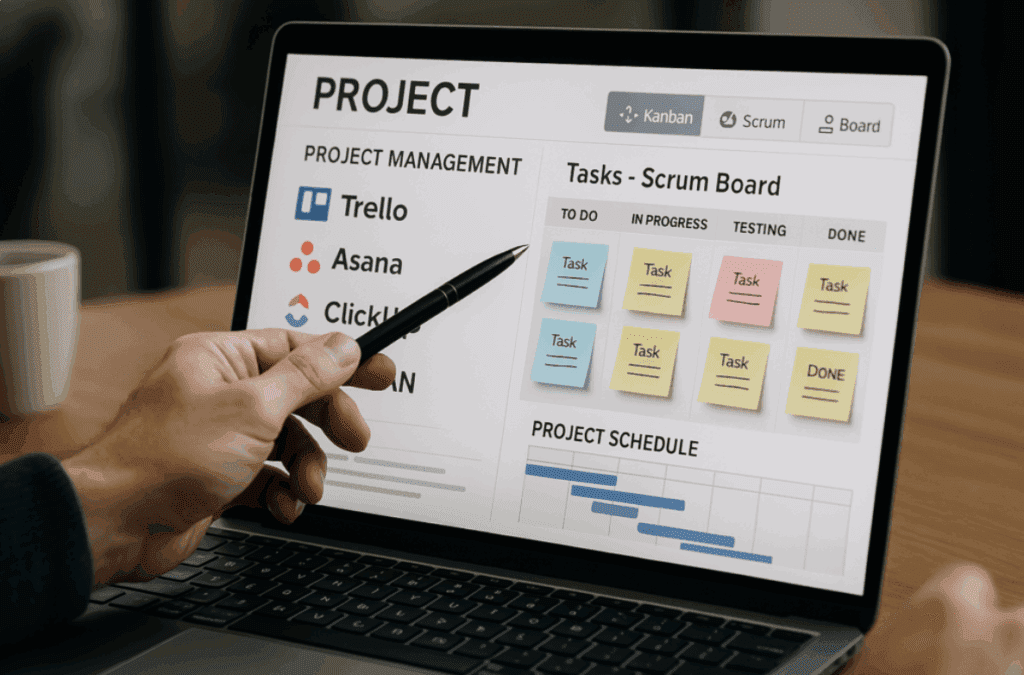
    5. Set up a daily routine for freelancing or consulting. Use contracts to outline expectations, milestones, and payment terms. Stay organized with tools like Trello, Asana, or Notion. Schedule time for both work and rest.
    6. Keep stress low by saying no to draining work, blocking rest time, and automating tasks like billing taxes and scheduling.

    Real Life Examples

    • An IT leader now does fractional consulting on infrastructure and system architecture projects for two or three days a week. He schedules everything remotely and chooses clients whose missions inspire him.
    • A marketing executive now freelances on campaign strategy and content editing work from home, focusing on clients that align with her values.
    • A finance professional does part-time bookkeeping for local nonprofits from her home, reducing stress and increasing satisfaction in her later years.

    Each person has found a way to become semi retired, find meaningful work, and remain financially supported.

    Another example of remote work illustrating both opportunity and caution involves a millennial who held three remote jobs and earned over half a million dollars a year. He used the extra income for renovating and investing, but ultimately quit one job due to its commute requirement and later rebalanced his commitments for sustainability. This story reminds us that remote work flexibility can empower people, but it must be managed to avoid burnout.

    Benefits of Becoming Semi Retired and Finding Meaningful Work

    • You gain space for family creativity, rest, and hobbies while remaining productive.
    • You stay socially engaged and keep your mind active, which promotes emotional well-being.
    • You maintain income and can contribute to retirement savings or delay Social Security if that benefits your future financial health.
    • You choose where and when you work.
    • You share wisdom, mentoring, or volunteering, helping create a legacy.

    Challenges and How to Handle Them

    Income can be inconsistent. You may need a buffer or a mix of income sources. You may need your favorite tools to connect with others through local groups or virtual communities. Your work identity may shift. You might find this easier if you phase out full-time work gradually or test hybrid paths. You may need to learn new skills or refresh your resume to make transitions. Small courses or workshops can help with that.

    Advanced Strategies to Maximize This Transition

    Unretirement or encore careers can offer ways to stay engaged without stress. You may work part-time while coaching or consulting. You might combine consulting, volunteer board membership, and short, engaging freelance assignments to build varied and meaningful weeks.

    Final Thoughts

    To become semi-retired and find meaningful work that pays you, begin with clarity about what matters most. Build on your strengths, explore roles that align with your rhythms and energies, and shape work to support your wellbeing. 

    Whether you choose remote freelancing part-time structured work, or volunteering, the path is yours to design. You do not need to stop working to live with purpose and ease. With intention balance and courage, you can create a semi retired life that is deeply meaningful.

    Subscribe to WhatWorksNext today and join a community dedicated to transforming the way we work. Working smarter starts here!

  • No-Work Rule After 6 PM?  How It Changes Your Life

    No-Work Rule After 6 PM? How It Changes Your Life

    Do you often find yourself replying to work from home emails late at night, or scrolling through Slack messages while eating dinner? In today’s always-connected world, it’s easy to blur the lines between work and personal life. The idea of a No-Work Rule After 6 PM might sound radical, but for many, it’s becoming a necessary shift—a conscious decision to prioritize mental health, relationships, and overall well-being.

    Let’s dive into five reasons why setting boundaries after work isn’t just good for you—it’s essential.

    1 – Reduces Stress and Prevents Burnout

    Reduces Stress and Prevents Burnout

    When your day never really ends, and your work from home routine stretches late into the evening, it leads to chronic stress and burnout.

    Constant notifications, emails, and “quick tasks” prevent your brain and body from resting. By setting a clear boundary and ending your workday at 6 PM, you allow yourself the mental and physical space to unwind. No-Work Rule After 6 PM, this separation between work and personal life is essential for reducing anxiety and promoting overall mental health. Rest is not a luxury – it’s a necessity.

    2. Enhances Productivity During Work Hours

    enhance productivity during work hours

    A defined end to your workday creates a sense of urgency and focus. Knowing you need to wrap up by 6 PM encourages you to prioritize tasks, avoid procrastination, and manage time more effectively. This leads to higher productivity during working hours and helps you leave the day feeling accomplished. Plus, once the clock strikes 6 PM, you can fully disconnect without guilt, knowing you’ve made the most of your working time. 

    3. Improves Work-Life Balance

    Improve Work-Life Balance

    It’s easy to think everything’s urgent, but the reality is that much of it can wait until tomorrow. Setting boundaries allows you to carve out evenings for relaxation, hobbies, family, and self-care. This balance is vital for long-term well-being, especially when navigating the unique challenges of remote work.

    Without clear boundaries, the risk of burnout increases, but with them, you can enjoy both professional success and a fulfilling personal life.

    4. Strengthens Personal Relationships

    Strengthens Personal Relationships

    When you’re fully present in the evening, you can deepen your connections with family and friends. This presence “free from work distractions” creates stronger bonds, better communication, and more meaningful interactions. Whether it’s sharing a meal, having a conversation, or just being there, these moments matter. Boundaries signal to others that they’re a priority, which builds trust and strengthens relationships. Even amidst remote work challenges, personal connections remain a cornerstone of well-being.

    5. Promotes Better Sleep and Health

    Promotes Better Sleep and Health

    Working late into the night disrupts natural sleep patterns, leading to fatigue and reduced cognitive performance the next day. By stopping work at 6 PM, you give your body and mind the chance to transition into rest mode. This leads to higher-quality sleep, better health, and greater overall resilience. Whether you’re tackling tasks at a bustling office or navigating your home office setup, rest is the key to showing up refreshed and ready to focus.

    How to Implement the No-Work Rule After 6 PM?

    • Communicate Your Boundaries: Let your team, colleagues, or clients know your working hours. Setting clear expectations reduces after-hours interruptions.
    • Use Tools to Support Boundaries: Activate “Do Not Disturb” modes on your devices. Calendar blocks can reinforce your personal time.
    • Create a Shutdown Ritual: Close your laptop, organize your home office setup, and mentally switch off from work mode.
    • Stand Firm Against Pressure: It’s tempting to check that one last email or reply to a late message. But holding your boundary—even in the face of remote work challenges—is essential. Remember, boundaries are a form of self-respect and a key to sustainable success.

    Final Thoughts About No-Work Rule After 6 PM

    Adopting a “No-Work Rule After 6 PM” isn’t just about ending the workday; it’s about reclaiming time for yourself, your health, and your relationships. By doing so, you’re not only creating a better balance but also inspiring those around you to do the same. It’s a commitment to working smarter, living better, and embracing the future of work.

  • 10 Simple Desk Exercises to Stay Active While Working

    10 Simple Desk Exercises to Stay Active While Working

    If you’re like me and spend most of your day glued to a chair, it’s easy to forget your body needs movement to thrive. That’s where desk exercises to stay active come in. And it’s essential to have small breaks and some sort of easy stretching and exercising, otherwise you’ll become a dead dummy.

    These simple, effective movements help counteract the stiffness and fatigue that comes as an extra treat while working long hours at a desk.

    From boosting blood circulation to keeping your muscles engaged, these small desk exercises to stay active can make a big difference in how you feel, think, and work.

    Simple Desk Exercises To Stay Active

    Here is the list of some desk exercises to stay active which you have to add into your life to make your life dreamful.

    1. Seated Torso Twist

    Desk Exercises to Stay Active

    This is my go-to move when I feel my back stiffening up. Sit upright in your chair, feet flat on the floor, and gently twist your torso to the right, grabbing the back of your chair with your right hand. Hold for 10–15 seconds, breathing deeply, then switch to the other side. 

    It’s a great stretch for your spine and lower back, two areas that often suffer during long hours of a desk job. It sneaks in a quick break for your brain, too.

    2. Wrist Rolls and Finger Stretches

    Wrist Rolls and Finger Stretches

    Typing all day can turn your hands into little stiff claws, and sometimes it hurts. I’ve been there (quite a few times). 

    To tackle it, stretch your fingers wide, hold for 5 seconds, then make a tight fist. Repeat a few times. Follow that with gentle wrist rolls in both directions. These desk exercises to stay active help maintain flexibility, reduce stiffness, and may help prevent carpal tunnel.

    I like doing them during loading screens or right before typing marathons. It’s low effort but very effective for keeping your hands and wrists pain-free. Gotta take care of your joints before anything else!

    3. Desk Push-Ups

    Desk Push-Ups

    No gym? No problem. Stand at arm’s length from your desk, place your hands on the edge, and lower your chest toward the desk, then push back up. You’ve just done a desk push-up! Btw, you don’t have to do 3-3 sets; just 4-6 push-ups would be enough to unstiffen your body.

    These are great for your chest, shoulders, and triceps, and they get your heart rate up a little, too. 

    If you’re wondering how to stay fit with a desk job, adding desk exercises to stay active into your routine once or twice a day is a great place to start. Plus, it’s kind of fun! 

    Work will never end, but you may! So, make sure to take some time from your busy routine to do these quick desk exercises to stay active.

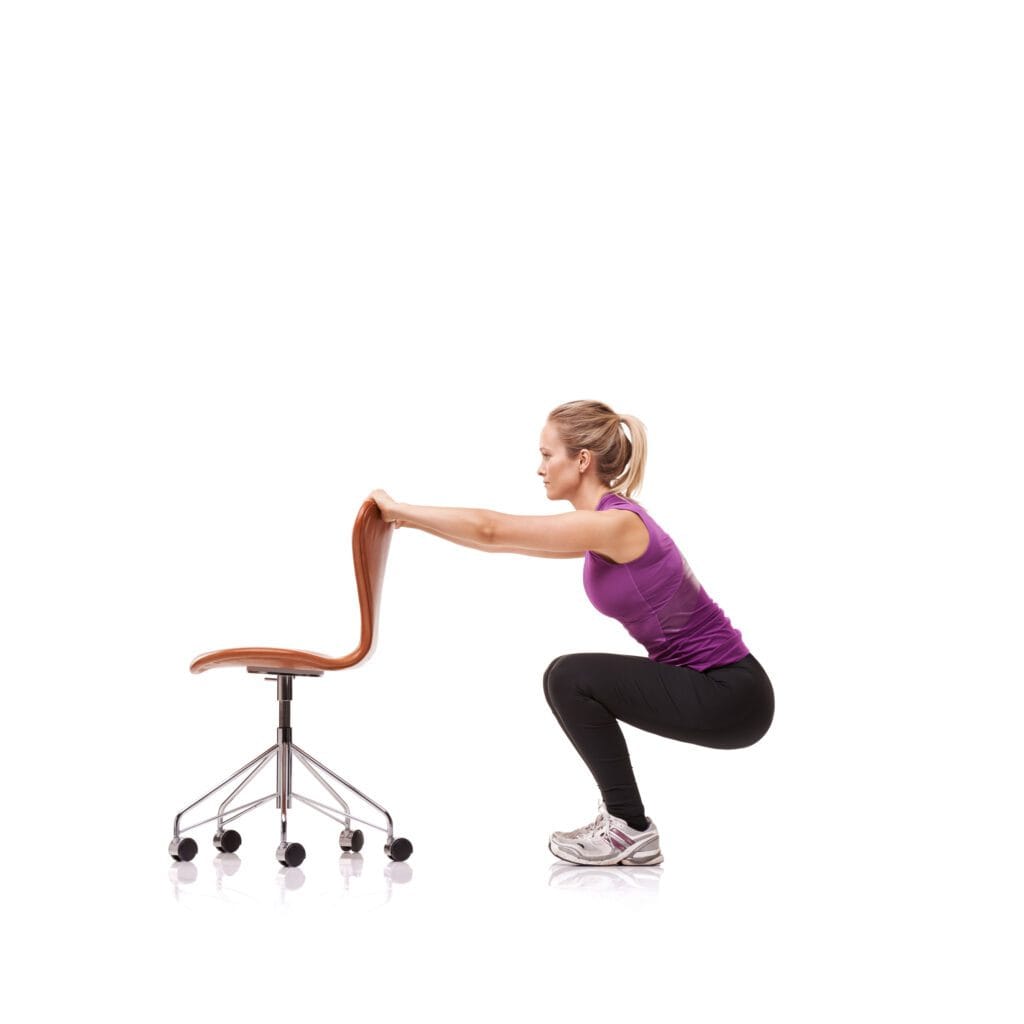
    4. Chair Squats

    chair squats while working from home

    I used to think you needed a gym to work your legs, but this exercise proved me wrong. Stand in front of your chair, slowly lower yourself down until you’re almost seated, then push back up.

    Do 10-15 reps to get your blood flowing. It works your thighs, glutes, and even your core. These desk exercises to stay active is also a great excuse to stand up and reset your posture during long work sessions. And trust me, your legs will feel the burn in the best way.

    5. Shoulder Rolls

    shoulder rolls from desk exercises

    Shoulder tension is the silent productivity killer, and this easy move helps shake it off – literally. Sit or stand tall, roll your shoulders forward in slow circles for 10 seconds, then reverse. I used to do this in my childhood for fun, not it has become a necessity.

    It sounds simple, but it releases built-up tension from stress or poor posture. I often do this when I’m reading emails or during meetings (obviously with no camera on). It’s a quick fix that improves posture and makes you more mindful of how you’re sitting throughout the day. Consider this your mini shoulder reset. 

    6. Ankle Pumps and Circles

    Ankle Pumps and Circles

    Don’t underestimate the power of your ankles. Sitting for hours reduces blood flow to your lower legs, which can cause swelling or stiffness. While seated, lift one leg off the ground and rotate your ankle clockwise and then counterclockwise at least 8-10 times. 

    Switch legs and repeat. You can also pump your toes up and down as if pressing a gas pedal. These desk exercises to stay active are sneaky but powerful. They help improve circulation and are a must if you tend to cross your legs a lot, like I do.

    7. Neck Tilts and Turns

    neck tilts and turns exercise from desk

    Nothing screams “desk fatigue” like a stiff neck. Start by gently dropping your right ear toward your right shoulder. Hold for a few seconds, then switch sides. Then slowly turn your head left to right like you’re scanning the room. These moves help reduce neck tension and realign your spine. 

    I like doing this while waiting for my coffee to brew or during long calls. It’s a great way to avoid tech neck and keep your upper body relaxed and mobile.

    8. Seated Leg Lifts

    Seated Leg Lifts exercise from desk

    Leg day at your desk? Yes, please. Sit tall, extend one leg out straight in front of you, hold for five seconds, and then lower it back down. Alternate between both legs for 10-12 reps. You can also pulse at the top to engage your thighs more. These desk exercises to stay active activates your core and lower body, improving strength and blood flow. 

    I often sneak these in while answering emails or doing some small tasks. It’s multitasking, fitness-style – no sweat (literally).

    9. Standing Calf Raises

    Standing Calf Raises

    You don’t need sneakers for this one. Just stand up behind your chair, hold the back for balance, and rise up onto your tiptoes. Hold for a second, then lower down slowly. Do 15-20 reps. 

    This simple move strengthens your calves, improves balance, and wakes up your legs after a long sit. I do them when I’m microwaving lunch or even while brushing my teeth (because why not?). It’s a fun, easy way to stay active with a desk job.

    10. Eye Breaks and Focus Shifts

    Eye Breaks and Focus Shifts

    Let’s not forget your eyes, they’re working hard too. The 20-20-20 rule is a lifesaver: every 20 minutes, look at something 20 feet away for at least 20 seconds. It helps reduce eye strain and keeps you from zoning out (we’ve all been there). 

    I pair this with a few slow blinks and some deep breaths to reset mentally and physically. It may not seem like a traditional exercise while sitting at desk, but it’s vital for staying energized and focused throughout the day.

    Final Thoughts About Desk Exercises To Stay Active

    Adding desk exercises to stay active into your daily routine isn’t about getting ripped at your desk. It’s about keeping your body moving, even in small ways, to feel relaxed. These movements are proof that a little goes a long way, especially when working long hours in front of a screen.

    From stretches to leg lifts and everything in between, these simple habits can seriously improve how you feel by the end of the day. So the next time your energy dips or your posture slumps, give one of these moves a try. 

    Subscribe to WhatWorksNext today and join a community dedicated to transforming the way we work. Working smarter starts here

  • 10 Minimalist Home Office Setup Ideas for Small Spaces

    10 Minimalist Home Office Setup Ideas for Small Spaces

    These 10 minimalist home office setup ideas prove that even the smallest spaces can be transformed into stylish and efficient home offices. With a dash of creativity (and maybe a pinch of humor), you’ll see that when it comes to a minimalist home office, less space doesn’t mean less fabulous!

    I have a reasonably decent-sized room, and yet I sometimes struggle to have a fine home office setup. Btw, I like revamping my home office setup quite often, so I keep trying different ideas. Sharing some of these here, as they might help you with the indecisiveness as well.

    Here are some ideas for Home office setup

    Creating the perfect home office setup is essential for boosting productivity and maintaining work-life balance. A well-designed space should combine comfort, functionality, and personal style. From ergonomic furniture to smart storage solutions, every element plays a role. Explore creative ideas to transform your space into an efficient and inspiring home office setup.

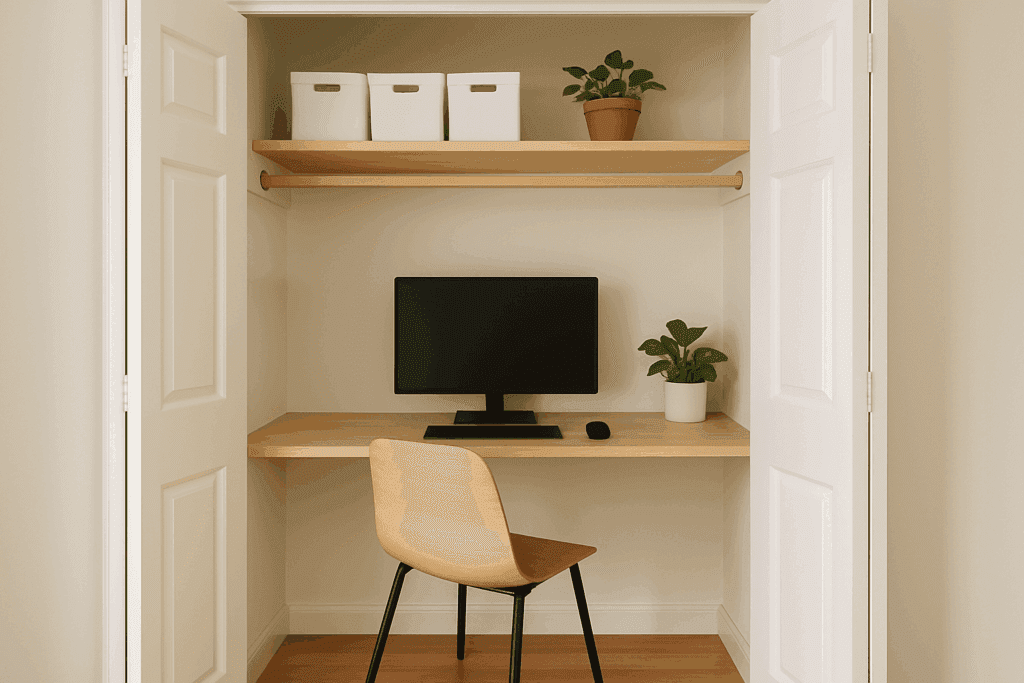
    1. Cloffice: Closet Turned Office

    Cloffice: Closet Turned Office

    What? A closet? Who says a closet is just for clothes? Turn that spare closet into a “cloffice” (closet + office) and create a hidden work haven. 

    All it takes is a small desk, a wall-mounted shelf, and maybe a touch of light and décor. When the workday is over, close the closet doors, and poof! Your office vanishes – minimalist home office magic!

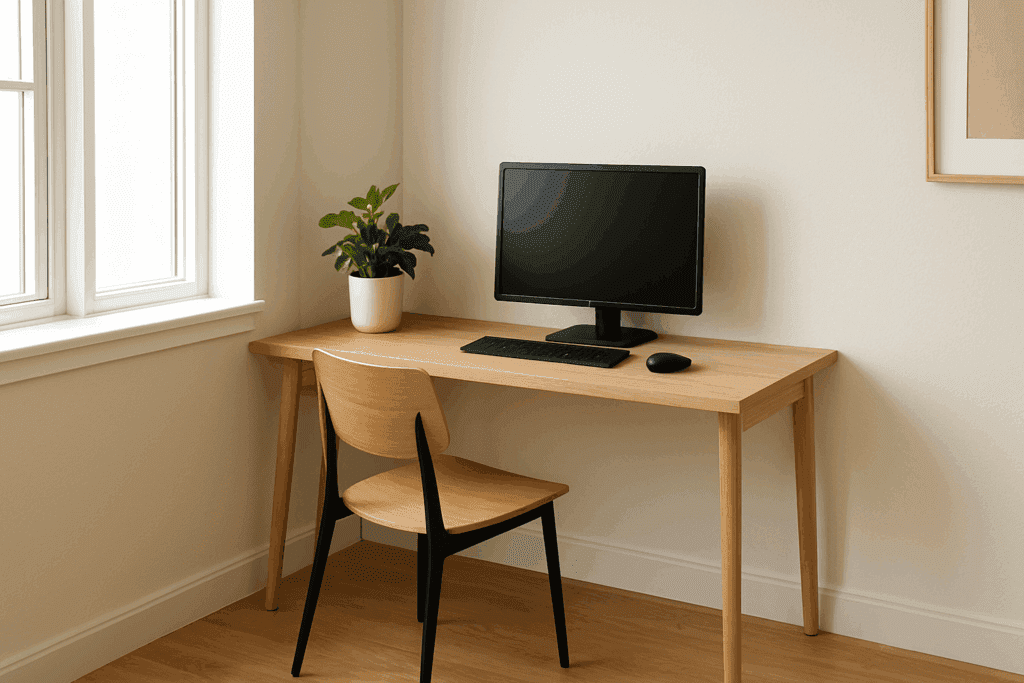
    2. Corner Office, Literally: Cozy Corner Nook

    Corner Office, Literally: Cozy Corner Nook

    Claim an unused corner and give yourself a literal corner office. A small L-shaped desk or a simple writing table tucked into a corner makes an instant minimalist home office. This smart Home Office Setup uses space that would otherwise gather dust bunnies. 

    Plus, you’ll feel a tiny bit like an executive whenever you tell people you have a “corner office” at home! 

    3. Floating Desk: Wall-Mounted Wonder

    Wall-Mounted Floating Desk at Home

    Save space with a wall-mounted desk. A floating desk attached to the wall gives you a workspace without gobbling up any floor area. Think of it as a shelf that works overtime as your office. Pair it with a sleek stool that slips under when not in use. 

    This minimalist home office setup idea keeps your small space feeling open, airy, and trip-hazard free.

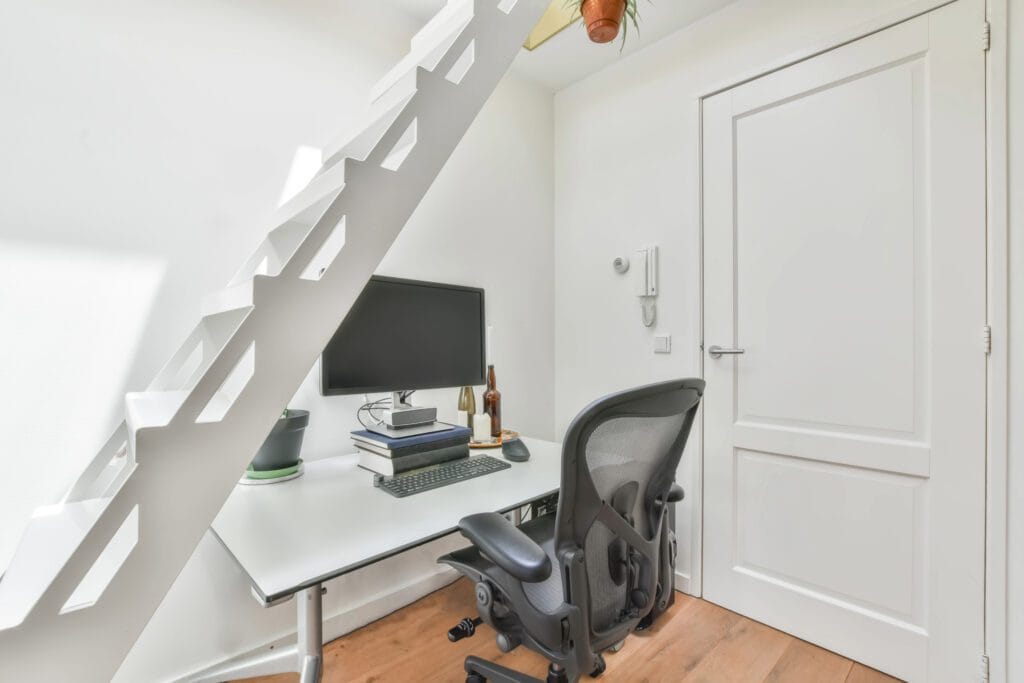
    4. Under-Stair Station: Sneaky Workspace

    Under-Stair Station: Sneaky Workspace

    The space under the stairs often collects dust. Why not give it a promotion to a home office? Clean it out, it doesn’t have to be your storage dump space as well.  

    Slip a petite desk and a chair into that nook, and you’ve got a minimal, cute little workspace. Built-in storage under the stairs can keep files and clutter out of sight. This is one of those small office ideas that hides in plain view, turning dead space into a productivity spot.

    I had to move my stuff from the under-stair area as my mom wanted to utilise it for the empty cartons ? (you know that’s more important anyway).

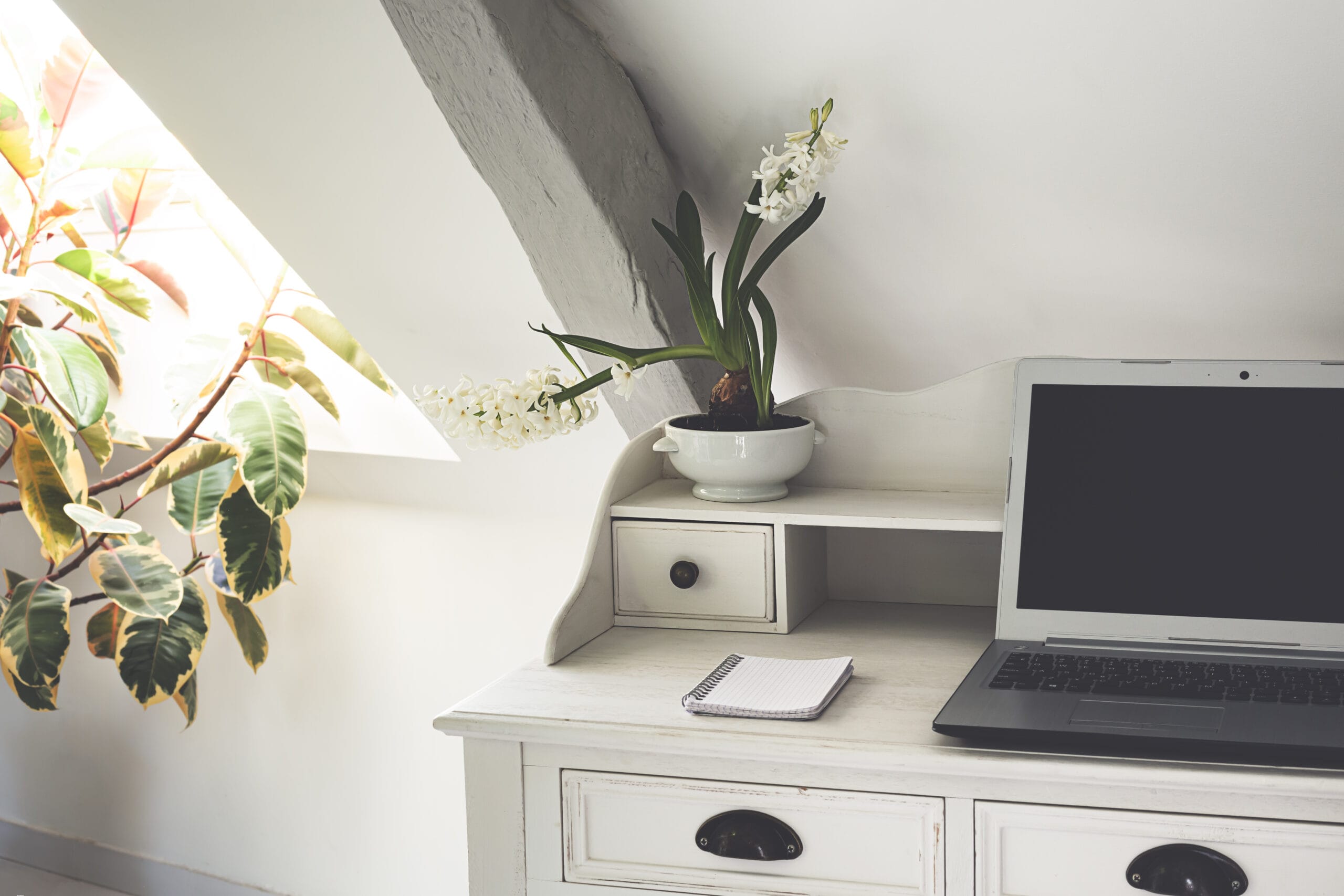
    5. Turn a Vanity Table Into a Stylish Workstation

    Turn a Vanity Table Into a Stylish Workstation

    When you’re short on space but still need a functional home office setup. Think creatively, your bedroom vanity can easily double as a minimalist desk. Repurpose it by clearing off personal items and adding work essentials like a laptop, notebook, and maybe a small plant for a productivity boost. 

    To make it feel like its own cozy nook, define the area with playful wallpaper or a bold accent wall. Swap out bulky lamps for a wall-mounted sconce to keep the surface clutter-free. It’s a clever way to blend beauty and function without compromising either.

    6. Use a Room Divider

    Use a Room Divider

    A room divider is a smart solution for separating a dedicated home office space without major renovations. Whether you’re working in a living room, bedroom, or studio apartment, a decent divider adds structure to your layout and signals a visual and psychological boundary between work and leisure zones. 

    You can opt for folding screens, lightweight bookcases, or even fabric curtains mounted on a ceiling track to create a separate zone. Whatever you think can be utilised for this, you don’t have to spend a lot. Utilise the things you have at home and see a way around. 

    Home office setup not only offers privacy during virtual meetings but also helps reduce distractions and improve focus during work hours.

    7. Choose Multifunctional Furniture

    Choose Multifunctional Furniture

    When space is limited, multifunctional furniture becomes essential for optimizing every inch. 

    Consider pieces that serve dual or even triple purposes, like an ottoman that opens for storage, a wall-mounted desk, or a folding chair that can fold away when not in use. A dining table can double as a work surface during the day, and a storage bench can act as both seating and a place to keep office supplies. 

    The key is to invest in smart, adaptable furniture that fits your lifestyle and helps reduce clutter while maintaining a professional-looking space.

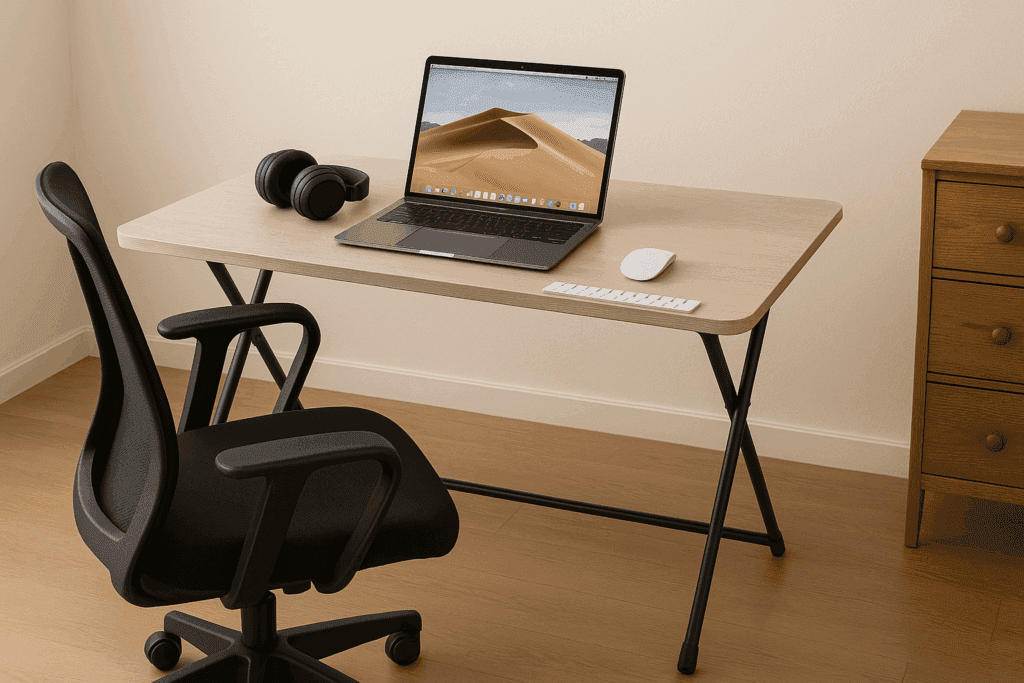
    8. Use Portable Foldable Desks

    Use Portable Foldable Desks

    Portable, foldable tables are perfect for people who need a flexible and temporary setup ( I have a small portable table and it goes with me wherever I move around the house, lol).

    These desks can be set up in minutes and stored away just as easily, making them ideal for those who don’t have a permanent space to work from. You can bring them out during work hours, then tuck them behind a door or under a bed once you’re done.

    They’re also great for those who like to change their work environment throughout the day (someone like me who doesn’t like to sit in one place for a long time).

    9. A Study Space by Day, a Dining Room by Night

    A Study Space by Day, a Dining Room by Night

    In many small homes, the dining area is one of the few available spots with a flat surface and decent lighting – two essentials for productive work.

    So, by being intentional with furniture placement and accessories, you can transform this area into a functional study zone during the day and switch it back to a cozy dining setup in the evening.

    Rolling storage carts can be tucked into corners to hold office supplies, and minimal décor helps maintain the dual-purpose functionality. The versatility of this space-saving idea is ideal for small apartments and shared households.

    10. Convert Garage into Home Office

    Convert Garage into Home Office

    If you have a garage at home, you can leverage the space for setting up your work zone. Converting a garage into a home office can be a game-changer for those needing a completely separate workspace within their home.

    With proper insulation, ventilation, and lighting upgrades, this underutilized area can be turned into a quiet, professional environment.

    Add electrical outlets, ergonomic furniture, and perhaps a few personal touches like plants or artwork to make it inviting. A converted garage provides the benefit of physical separation from the main living space, which can greatly improve focus and help maintain work-life balance, especially for those who work full-time from home.

    Final Thoughts About Home Office Setup

    In conclusion, investing time and effort into designing a thoughtful home office setup can significantly enhance your productivity, focus, and overall well-being. Whether you’re working remotely full-time or just need a dedicated space for occasional tasks, the right setup makes a big difference.

    With a pinch of creativity, even the tiniest nook can become your productivity zone, helping you keep a work-life balance. 

    The key to a great home office setup in a small space is embracing the minimalist mantra: less clutter, more clever. 

    Mix and match these tips to craft your own cozy mix that aligns the best with your space and taste.

    Subscribe to What Works Next today and join a community dedicated to transforming the way we work. Working smarter starts here!

  • Tips to Set Up a Perfect Home Office for Productivity

    Tips to Set Up a Perfect Home Office for Productivity

    A well-designed home office setup isn’t just about aesthetics only (I know, I know it matters!). It’s a must-have setup for better focus, comfort, and productivity. Whether you’re new to remote work or just looking to upgrade your space as a settled WFH employee, it’s time to set up a perfect home office that works with you, for you, and not against you.

    After working from home for almost half a decade, I have experienced, learned, and relearned many things that have helped me maximize my productivity. It hasn’t been easy, but we all gotta learn as we grow, especially when it comes to setting up your home office for your own good! So, I thought of sharing my two cents on how you can improve your productivity while working remotely. 

    But first, let’s throw in some reality checks. Working from home sounds like a dream until you’re typing away on your laptop from the couch, balancing it on a pillow, wondering why your back feels like it aged a decade. 

    Let’s jump in and learn about some tips that might help you build a modern, productive home workspace that looks good, feels better, and functions like a dream.

    How to Set Up a Perfect Home Office

    Create a comfortable, productive workspace at home by choosing the right furniture, lighting, and technology. Prioritize ergonomics, minimize distractions, and personalize your environment for maximum efficiency. Whether for remote work or freelancing, knowing how to set up a perfect home office can boost focus and performance.

    Designing the ideal home office starts with selecting a quiet, well-lit area that encourages concentration. Invest in a supportive chair, a spacious desk, and essential tools like a reliable computer and high-speed internet. Keep your setup organized with smart storage solutions and add personal touches to inspire creativity. When you Set Up a Perfect Home Office, you create a space that enhances both comfort and productivity.

    1. Designate a Dedicated Work Zone

    This may sound too basic, and you’ll be like ya right as if I don’t know about this…I know, but sometimes even despite knowing something, we tend to ignore it until it hits back (literally your back – remember the laptop placement on your lap while adjusting the pillow for your back?) Yeah…so time to transition those “I know thoughts’ into something actionable – by creating and designating a dedicated work zone for yourself with proper equipment. 

    So, the first step in creating the best home office setup for productivity is defining a workspace that’s just for work. Even if you don’t have a spare room, a quiet corner or a sectioned-off nook will do the trick. Physically separating your work area from your space signals to your brain that it’s “go time” when you sit down.

    Invest in comfortable work chairs and desks, I’ll talk about it further in the next point. 

    Tip: Use rugs, white lights, or high high-standing lamp, or even indoor plants for your home office space to create a visual boundary if you’re sharing a room or utilising the same space for work and personal stuff. 

    Designate a Dedicated Work Space for Home Office Setup

    2. Invest in Ergonomic Furniture and Accessories

    It’s truly time to say goodbye to the constant neck pain and awkward, hunched-over typing. I took some time to do this, you shouldn’t! It affected my back so badly that I still feel recurring pain sometimes. Have some mercy on yourself and go sit in a chair!

    Invest in an ergonomic chair that offers lumbar support and adjustable features. Pair it with a functional desk, preferably a home office desk with drawers, that gives you room to work without clutter.

    Your monitor should be at eye level (if you have the budget, you can also invest in electric standing desks and adjust the height as per your preference and needs), your arms at a 90-degree angle, and your feet flat on the floor or use a foot support to avoid puffy feet. This classic setup boosts comfort and helps prevent long-term strain.

    Do take breaks, though! Apart from having all the right equipment, your body needs movement. Take a 5mins break after every 1 hour. It helps with focus and productivity.

    Ergonomic Furniture for home office setup

    3. Let There Be Light (Natural Light, If Possible!)

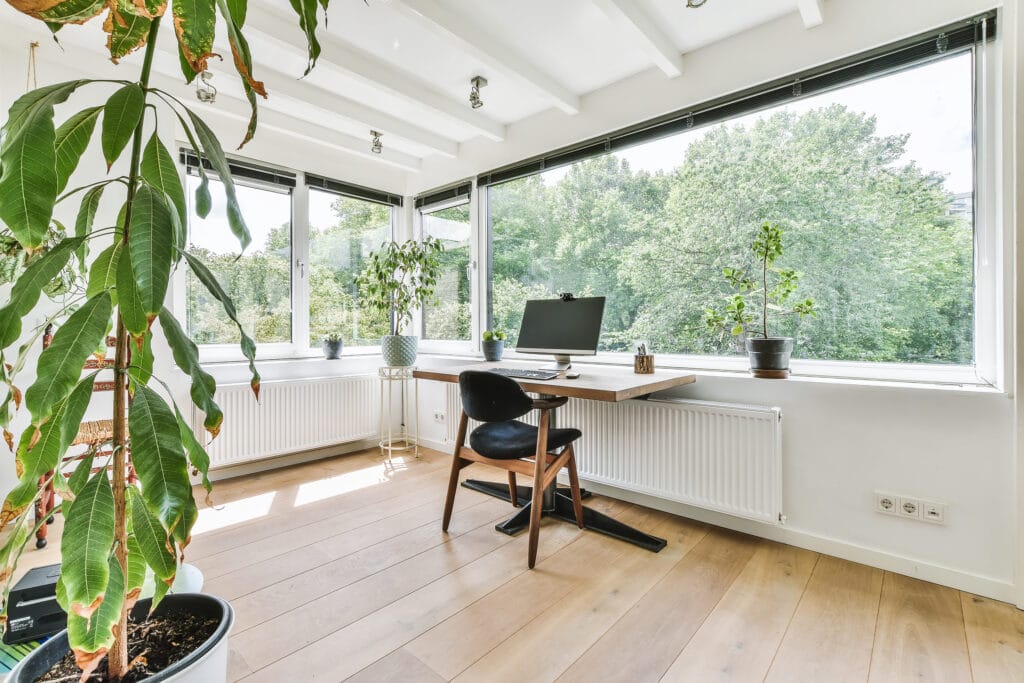
    Lighting is a game-changer in any productive home office setup. Natural light improves mood and alertness while reducing eye strain. If possible, position your desk near a window. No window? Use a full-spectrum daylight lamp or LED desk light that mimics natural light. You can find budget-friendly indoor lamps online. 

    You can also look for home sales around your place. You may find something cheap yet valuable for lighting up your workspace. 

    Home Office Setup Natural Light and Indoor Plants

    4. Upgrade Your Tech Stack

    If you’re working from a single laptop screen with a tangled mess of cables, it’s time to level up. There are hundreds of productivity boosting gadgets and tools that you can use as per your needs. Consider adding a second monitor to expand your screen space, a wireless keyboard and mouse for comfort, and a quality webcam and microphone for clear communication. A good docking station can also help reduce cable clutter and streamline connectivity. These upgrades not only improve efficiency but also make your workspace more enjoyable. Investing in the right tech is a smart way to Set Up a Perfect Home Office.
    However, here are a few productivity-boosting essentials that you can start with:

    Best Monitors for Home Office: 

    You can find a cheap one, but can you compromise on your eyesight? Nope. Can you compromise on the quality of visuals/graphics? Nope. Hence, investing in best best-performing monitors can enhance your overall workflow. A dual-screen setup can drastically improve efficiency and multitasking.

    Best Headset for Working from Home: 

    You can find multiple handsets in the market. However, getting noise-canceling headsets keeps distractions at bay during calls, especially when you are working from home with other people in the house (or imagine kids, lol). 

    Tech Accessories: 

    Only the table and chair won’t do. Invest in laptop risers (if you use a laptop), and for monitors, you can invest in wall-mount stands for monitors. Wireless keyboards and mouse should be in your tech stack list because managing tangled wires isn’t easy to deal with, and have USB hubs to keep your desk sleek and functional.

    Remember, the most important thing is your Wi-Fi speed and overall setup. It’s the foundation of all remote work. Consider it your workflow’s lifeline.

    Tech Stack for Home Office Setup as a WFH employee

    5. Keep It Organized, Keep It Efficient

    Cluttered desk = cluttered mind. If I talk about myself, my OCD doesn’t let me focus without an organized desk. So, I always keep it aligned before starting my work so that I don’t get distracted or annoyed by it. 

    You can use shelves, file organizers, cable trays, and drawer units to keep your workspace neat. Set up a perfect home office with built-in storage or nearby cabinets will help you avoid digging through drawers or piles of paper mid-task.

    Try this: At the start and end of each day, take 3 minutes to reset your space. It’s a small habit that makes a big difference.

    WFH keep your desk organised ideas

    6. Control Distractions Like a Pro

    Working from home comes with its own set of challenges, like the fridge calling your name or a rabbit hole of tabs you “accidentally” opened. Or something from 5 years ago started a combat within your thoughts. It’s natural and it happens. However, we must try to combat these distractions by set up a perfect home office:

    • Time-blocking techniques (Pomodoro works wonders)
    • 5 minutes of focused breathing techniques (just inhale from the nose, exhale from the mouth, with your eyes closed)
    • Use website blockers during deep work sessions
    • Keep your phone on silent and upside down so that you don’t check it every 5 seconds
    • Noise-reducing accessories like noise-cancelling headsets or you can use foam earplugs, mostly used for sleeping with reduced surrounding noises, but you are not going to use them to sleep on your work desk, ok? Use them as noise reduction buds

    A focused environment = more done in less time. That’s what a productive home office setup is all about.

    how to stay focused while working from home

    7. Add Personality And Inspiration

    Don’t forget the final, but a fun step, which is making the space yours. Own it, nurture it so that you feel comfortable and productive in that environment. A workspace should be more than functional, it should spark joy and motivation. Think motivational quotes, your favorite artwork, or a splash of color that lifts your mood. These small touches can make a big difference in how energized and focused you feel. Personalizing your space is a powerful way to setup a perfect home office that inspires creativity and drive every day.

    • An indoor plant or two to freshen up the vibe. It helps you feel refreshed and calm
    • Motivational art, calming color schemes, or minimalist design, anything that aligns with your personality and preferences
    • Ambient lighting or a stylish lamp for mood and flair
    • If you are a collector of figurines, you can also put your favorite ones to make it more fun

    The more you enjoy your surroundings, the more time you’ll want to spend there, and the easier it becomes to stay productive.

    A well-designed workspace not only boosts motivation but also helps maintain a clear boundary between work and personal life. Add elements that reflect your personality—art, plants, or inspiring quotes—to make the space uniquely yours. Keep it tidy and clutter-free to encourage focus and clarity. When you set up a perfect home office, you create a space that supports both your professional goals and personal comfort. Taking the time to set up a perfect home office can transform how you feel about work every single day.

    Set up a perfect home office

    8. Maintain Work-Life Balance While You Set Up a Perfect Home Office

    When you set up a perfect home office, it’s easy to blur the lines between work hours and personal time. To maintain balance, create a routine that signals the start and end of your workday. Simple actions like shutting down your computer, changing your clothes, or stepping outside for a walk can help you mentally disconnect from work and recharge effectively.

    9. Revisit and Refresh Your Setup Regularly to Set Up a Perfect Home Office

    Your needs and work habits will evolve, so regularly evaluating your setup ensures it still serves you well. Rearranging furniture, updating equipment, or even changing your wall art can reignite motivation. When you set up a perfect home office and revisit it often, you keep your workspace dynamic, efficient, and aligned with your goals.

    10. Prioritize Health and Wellness as You Set Up a Perfect Home Office

    While you set up a perfect home office, don’t overlook your physical and mental health. Incorporate habits like stretching, standing breaks, and staying hydrated. You can also keep a yoga mat nearby or use a balance ball chair occasionally to keep your body active and your posture in check throughout the day.

    11. Budget-Friendly Ways to Set Up a Perfect Home Office

    You don’t need to break the bank to set up a perfect home office. Look for second-hand furniture, repurpose items you already own, and gradually upgrade your space over time. Focus on essentials first, like a good chair and lighting, then add in accessories and decor as your budget allows.

    Final Thoughts On Set Up a Perfect Home Office

    There you have it, a blueprint to set up a perfect home office that’s functional, inspiring, and productivity-ready. 

    From optimizing ergonomics and lighting to managing tech and keeping distractions in check, each detail plays a role in building the best home office setup for productivity.

    Ready to revamp your space? Start with one tip and build up over time. And if this guide helped you, feel free to share it with your fellow remote warriors. This is just a foundation for you to think and start. I am sure you can enhance it further by adding additional things. 

    Remember, the goal is to create a space that works for you—one that supports your workflow, boosts focus, and feels good to be in. Don’t hesitate to tweak and personalize as you go. Whether you have a whole room or just a corner, you can set up a perfect home office tailored to your needs. With consistency and creativity, you’ll find it easy to set up a perfect home office that truly elevates your work-from-home experience.

    Subscribe to WhatWorksNext today and join a community dedicated to transforming the way we work. Working smarter starts here!

  • 10 Tips On How to Work from Home with Kids

    10 Tips On How to Work from Home with Kids

    If you work from home with kids, you know it can feel like an extreme sport. Learning how to work from home effectively is one thing; figuring out how to work from home with kids is a whole new challenge (think marathon meets juggling act). 

    In 2025, remote work is still going strong, so if you’re wondering if working from home is still available in 2025, the answer is a resounding yes. Many companies continue to offer flexible or hybrid schedules. And to be honest, most of us with kids have gone through the process one way or another, so you are not alone!
    But the real question for parents is: How can you keep your sanity and manage work from home with kids? We’ll get into it in a moment; stay put!

    In the meantime, let’s first reminisce about who invented work from home with kids. Well, no single person “invented” work from home, but the concept of telecommuting dates back to the 1970s (a NASA engineer named Jack Nilles coined “telecommuting” in 1973​. Fast forward to today, work from home with kids is a normal reality for millions, especially after COVID-19. 

    Now, let’s talk about the real shiz, I am going to share some tips which we (our married team members with kids and the people in our circle have shared). We will talk about some actual tips for work from home with kids that will help you stay productive without losing your sanity (or your laptop to a flying sippy cup).

    Behold and read along the 10 sanity-saving tips, each packed with fun and pun-filled advice for parents working from home with kids:

    1. Stick to a Routine (But Expect Detours)

    Kids thrive on routine, and let’s face it, so do we adults. Try to create a family schedule that outlines when you work and when you’re on parent duty. For example, set core work hours around nap times or school times, and have consistent lunch and snack breaks for the kids. A morning routine (even if it’s as simple as “coffee for you, cartoons for them”) signals that the workday is starting. 

    Working from home with kids often means your day won’t always go as planned (cue the toddler tantrum at 10 AM), so build in buffer time. Think of your routine as a road map, useful for direction, but flexible enough to take an alternate route when life (or your toddler) throws a toy in your path.

    It’s important to communicate your routine with your kids, even if they’re young—simple explanations help set expectations. Visual schedules or routine charts can also keep them engaged and aware of what’s coming next. When you work from home with kids, structure helps reduce chaos and gives everyone a sense of stability, making it easier to balance both roles.

    WFH with children Stick to a Routine (But Expect Detours)

    2. Create a Kid-Friendly Workspace While Work From Home With Kids

    Having a dedicated workspace helps you get into “work mode” and signals to your kids that you’re busy. If possible, set up a home office or a desk in a low-traffic area of the house. Explain to the kids that when you’re in your special chair or wearing your headset, it’s work time (a simple door sign or red-green light system can work wonders,  green means “come in,” red means “on a Zoom call, do not disturb unless it’s an emergency or a cookie-related crisis”). It’s tricky, but practicing it daily can help. 

    Make the space kid-resistant. Keep important wires, devices, and that oh-so-tempting big red “End Call” button out of reach. You can even set up a kids’ corner nearby with coloring books or puzzles, so they feel included, but not literally on your lap during meetings. By carving out a semi-kid-free zone (hey, we can dream!), you can establish a boundary between work and play, even if it’s just a symbolic one.

    Create a Kid-Friendly Workspace

    3. Nap Time = Power Hour

    Every parent’s favorite four-letter word: N-A-P-S

    During nap time (or the much-appreciated “quiet time” for older kids), maximize your productivity. Plan your most focus-intensive tasks for those golden quiet moments. It might be tempting to do dishes or laundry while the house is finally silent, but remember that work time is hard to come by, so use it wisely for deep work or important calls. 

    If your kids are past the napping stage, consider instituting a daily quiet time where everyone reads, does puzzles, or engages in a calm solo activity. (No, sneakily hiding in the bathroom for a break isn’t officially quiet time, but we’ve all been there.) You’ll be amazed at how much you can get done in an hour of kid-free quiet. 

    Bonus tip: If you have an important meeting, try a pre-emptive energy burn – a quick dance party or backyard play session before call time can help tire the kids out. So they’re more likely to chill while you work.

    4. Communicate and Set Boundaries

    Clear communication is your BFF when you work from home with kids. Let your boss and team know your schedule constraints. For instance, “I take calls after 10 AM, once I’ve dispatched the kids to school or settled them with an activity.” Most employers in 2025 understand the drill (many are juggling the same issues). If you have to step away to handle a toddler meltdown, be honest and don’t panic. Setting expectations with colleagues means fewer raised eyebrows when a child pops up on your video call. 

    Likewise, set boundaries at home. Explain in simple terms to your kids when they can interrupt you (pro tip: define what an “emergency” is. Hint: it’s not finding out the Wi-Fi password to watch Frozen for the 47th time). 

    Use visual cues. For example, a closed door or a “working hat” you wear signals that you’re in work mode. And remember the magic word: mute. The mute button lets you shush the chaos momentarily during conference calls (so your co-workers don’t hear you negotiating cookie-for-silence deals with your preschooler).

    Communicate and Set Boundaries with kids while working from home

    5. Let It Go (Perfection Is Overrated)

    When it comes to balancing career and kiddos at home, repeat after me: “Let it go.” (Yes, you can sing it if you want. We know you know the lyrics!). 

    One of the biggest tips for working from home with kids is to let go of perfection. Your home might get a bit messier, your workday might have odd pauses, and screen time for the kids might increase on tough days. And that’s okay! You’re not going to have the Pinterest-perfect home office or the productivity of an uninterrupted 9-to-5 worker every day. Embrace the occasional chaos.

    Prioritize what needs to get done each day, both for work and home. Allow yourself to be “good enough” with the rest. Did the kids have cereal for dinner once this week because you had a late meeting? They’ll survive. Did you send an email with a typo because you were rocking a baby with one arm while typing? It happens. Cut yourself some slack and channel your inner Elsa – let go of the guilt and unrealistic expectations.

    be natural and enjoy your time with kids even while working from home

    6. The Art of Distraction: Keep Kids Busy

    A distracted kid is a good kid (for us working parents, anyway!). Plan ahead to keep your little ones engaged while you work. Stock up an “office toy box” filled with special goodies that only come out during work hours. Think crayons, play-dough, puzzle books, or that one toy that actually holds their attention for more than 5 minutes. Rotate the contents to keep things novel. Encourage older kids to help out with simple chores or “jobs” if appropriate (you’d be surprised, some kids take sorting papers or stapling with serious dedication if you call them your “assistant”). 

    Also, don’t feel guilty about deploying some educational screen time when needed. An age-appropriate learning app or a nature documentary can be a lifesaver when you need uninterrupted time for a call. 

    The key is balance and variety: a bit of outdoor play in the backyard, a bit of coloring, maybe a scavenger hunt game around the house. By mixing it up, you can often buy yourself pockets of work time. 

    Remember, a little creative distraction goes a long way.  Sometimes, the best way to get your work done is to make sure the kids have something fun to do that doesn’t require your full attention every second.

    The Art of Distraction Keep Kids Busy as a work from home parent

    7. Smart Home Gadgets and Gizmos (Use Tech to Your Advantage)

    Let technology be your co-parent (it’s the 21st century, after all). A few well-chosen home gadgets can make working from home with kids a tad easier. For instance, a smart speaker can play lullabies or white noise for the baby while you’re on a call or even act as a friendly timer to remind older kids when “quiet time” is up. 

    Noise-cancelling headphones are practically a work-from-home uniform item now. They can help you focus (and blissfully tune out Baby Shark playing in the next room). If you have very young kids, a video baby monitor or a webcam in the playroom lets you keep an eye on them without constant interruptions. 

    You can also use tech to keep kids engaged: there are interactive toys and kid-friendly tablets loaded with educational games that hold their attention just long enough for you to send that important email. 

    Just use gadgets wisely and sparingly. You don’t need a tech overload, just a couple of trusty helpers. Remember, the goal is to enhance your day, not make it more complicated. A little Alexa here, a dash of Netflix there, and you’ll find a modern parenting groove that works for you.

    Smart Home Gadgets and Gizmos to engage kids at home

    8. Put On Your Oxygen Mask First (Self-Care Matters)

    When you’re juggling work and kids, it’s easy to forget about yourself. But taking care of your well-being is non-negotiable. Think of it as putting on your oxygen mask first so you can help others. Schedule a few mini-breaks in your day to recharge. This might mean waking up a bit early for a quiet cup of coffee or doing a quick 10-minute yoga stretch during lunch while the kids have a snack. 

    Step outside for a breath of fresh air when you can; even a short walk to the mailbox can clear the mind (bonus points if you can coax the kids outside with you for a mini “recess”). 

    Prioritize sleep and try to maintain a reasonable bedtime. Binge-watching one more episode at midnight isn’t worth it when you know a 6 AM toddler wake-up call is imminent. 

    Also, be kind to your mental health. Some days will be stressful, so find what helps you de-stress, whether it’s a warm bath, meditation, or calling a friend to vent (or laugh) about the day’s antics. Remember, you’re the engine that keeps the family machine running. A little self-care fuels you up to handle the next work deadline and the next round of “Mom/Dad, I need you!” with patience and grace.

    self care as a work from home parent

    9. Tag-Team and Ask for Help

    Even superheroes call in backup sometimes. If you have a partner at home, tag-team parenting is key. Coordinate your schedules to share childcare duties. For example, one of you covers breakfast and kid playtime from 8 am -10 am while the other gets a work sprint in, then swap roles. This “divide and conquer” strategy can give each parent some guaranteed focused work blocks. (Just be sure to occasionally have some full family time, so you’re not always ships passing in the hallway handing off the baby!). 

    If you’re a single parent or your partner isn’t available during the day, don’t be afraid to ask for help. This could mean trading off playdate time with a neighbor (they watch your kids one afternoon, and you watch theirs another) or leaning on a grandparent/relative for a virtual storytime session over video chat to occupy the little ones. 

    Hiring help is also an option if feasible. A part-time nanny or even a responsible local teen as a mother’s helper for a couple of hours can be a game changer. The bottom line: You don’t have to do it all alone. 

    As the saying goes, it takes a village! So assemble your village, whether it’s your spouse, family, friends, or paid help. Even a little support can go a long way toward maintaining your sanity and productivity.

    ask for help and support from peers and friends while working from home

    10. Embrace the Chaos and Cherish the Moments

    Our final (and perhaps most important) tip: keep a sense of humor and perspective. Working from home with kids is chaotic – no way around it. There will be moments when your Zoom meeting is joined by a pantless toddler or when your important client call coincides with a crayon-on-the-wall incident. Instead of letting these moments derail you, try to laugh them off when you can. 

    (Pro tip: Colleagues appreciate a bit of real-life levity – many are in the same boat, and a well-timed joke about “bring your kid to work day happening every day now” can break the tension.) 

    Also, remind yourself of the upsides of this crazy arrangement. You’re there for the little moments. The impromptu hugs, the first steps, or funny things your kids say at lunch moments, you might miss if you were at the office. Yes, your work may get interrupted, and your patience will be tested, but you also get to bond with your children in a way that working parents of past generations could only dream of. 

    So, embrace the madness: wear that toddler dress-up crown during a conference call if you have to, build that pillow fort for an afternoon break, and don’t feel guilty for enjoying the midday giggles. At the end of the day, your kids will remember the time you spent with them, and you’ll have kept your sanity by finding the joy amid the chaos.

    Embrace the Chaos and Cherish the Moments while working from home as a parent

    Final Thoughts On Work From Home With Kids

    Work from home with kids will always have its challenges, but with a bit of planning, a dash of creativity, and a healthy sense of humor, it’s absolutely doable without losing your sanity. 

    Use these 10 tips as a starting point to craft your own playbook for balance. Every family is different, so find the rhythm that works for you. 

    In the grand scheme, the work from home with kids juggle is a phase of life, and you will get through it. Someday, you might even miss the madness (well, parts of it!). Until then, keep calm, keep flexible, and keep those coffee refills coming. You’ve got this!

    Subscribe to What Works Next today and join a community dedicated to transforming the way we work. Working smarter starts here!
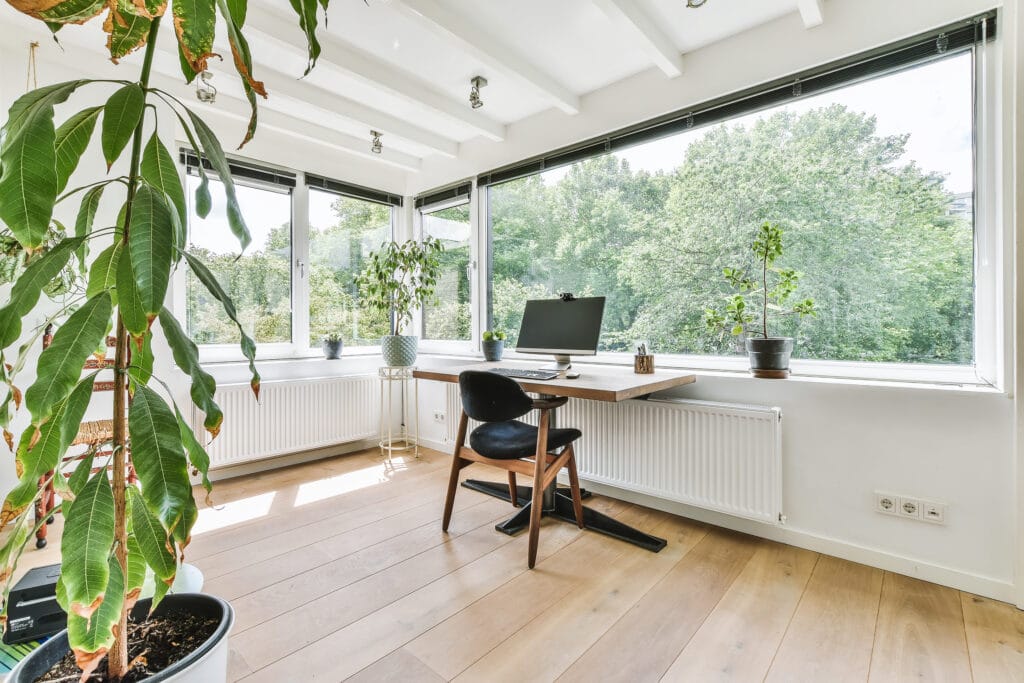
  • The Digital Skills You Need to Future-Proof Your Career

    The Digital Skills You Need to Future-Proof Your Career

    The digital landscape is evolving rapidly, as are expectations in today’s workplace. Whether you’re in marketing, tech, operations, or design, having the digital skills you need to future-proof your career is no longer optional; it’s mandatory!

    One day, you’re the office whiz with killer spreadsheets, and the next day, someone’s automating half of your workflow with AI and asking if you “speak data.”

    By 2025, around 85 million jobs may be displaced by a shift in labor between humans and machines, but 97 million new roles could emerge that are better suited to this new dynamic.

    If this made you sweat a little, don’t worry. You’re not alone. We all are part of this collective fear. The good news? There are plenty of digital skills you need to future-proof your career, and they’re totally learnable (no Matrix plug-in required).

    Let’s explore what are the most valuable Digital Skills You Need to Future in 2025 and how they can help people like you and me to build a sustainable, impactful career in the digital-first workplace.

    1. Data Fluency: Turning Information Into Strategic Action

    data fluency

    Nope, you don’t need to become a data scientist. But you do need to understand what the heck all those charts and dashboards mean.

    ? 76% of executives want more employees who know their way around data PwC. Why? Because data = decisions. And decisions = power moves.

    Start by learning how to read trends, and Digital Skills You Need to Future, ask thoughtful questions, and tell stories with numbers (bonus points if you can turn that into a killer deck).

    2. AI for Workflow Automation: Your Competitive Edge

    Ai for automation

    The conversation about AI has shifted from “Will it replace me?” to “How can I use it to work smarter?” That’s where AI for workflow automation comes in.

    ? Up to 50% of current work activities across industries could be automated using existing technology (source: McKinsey).

    Automation tools like Notion AI, Zapier, and Make.com allow non-tech professionals to create systems that handle repetitive tasks, giving you more time for strategic thinking and innovation.

    3. Strategic Thinking and Innovation: Human Intelligence at Its Best

    Strategic Thinking and Innovation

    As machines take over routine tasks, what remains uniquely human is strategic thinking and innovation. These skills turn challenges into opportunities and tools into transformation.

    • The smart folks at Deloitte say problem-solving and cognitive flexibility are chef’s kiss essential for the future of work.

    Being able to align business goals with digital solutions isn’t just a leadership skill it’s a survival skill in 2025.

    4. Remote Leadership: Managing Culture Across Screens

    Remote Leadership

    In an age of hybrid and remote teams, leadership is less about visibility and more about impactful communication, empathy, and outcome-driven coaching.

    • Leaders who communicate expectations can increase team engagement by up to 32%, even when working remotely (source: Gallup).

    Learning how to lead asynchronous meetings, motivate distributed teams, and foster belonging without physical proximity is crucial.

    5. Remote Project Management: Delivering Results Anywhere

    Remote Project Management

    If you’ve ever juggled tasks across five time zones while waiting for approval in a Slack thread…You already know the chaos. Welcome to remote project management.

    But here’s the deal: the chaos can be managed. Project managers with Agile certification earn 22% more. That’s a raise and a sanity boost.

    Being familiar with tools like Trello, Asana, or Click Up, and frameworks like Scrum or Kanban helps keep projects aligned and outcomes focused.

    6. Digital Communication and Collaboration: Beyond Emails and Zoom

    Digital Communication and Collaboration

    Clear, compelling communication is the glue of any successful digital team. But now, that communication must travel through Slack threads, Miro boards, Loom recordings, and async videos.

    Digital communication and collaboration are no longer just soft skills, they’re productivity enablers. 

    We need to learn to:

    • Adapt your tone across platforms.
    • Know when to use video vs. chat.
    • Provide context in async updates.

    These nuances build trust, reduce friction, and get things done in a decentralized workplace.

    7. Digital Strategy and Innovation: Big Picture Thinking

    Digital Strategy and Innovation

    We all know that being “good with tools” is nice. But being the one who knows why you’re using them and how they connect to business goals? That’s next level, and we certainly need to reach it!

    As per BCG, digitally mature companies are 26% more profitable than the rest. And guess who helps them stay that way? People who know how to link ideas, tools, and execution.

    About time we need to start thinking like strategists, about digital skills you need to future even if it’s not in our title (yet).

    8. Why Everyone Needs the Digital Skills You Need to Future

    No matter your industry—whether it’s healthcare, education, finance, or the creative arts—digital tools are shaping how we communicate, analyze, and deliver value. Being digitally fluent isn’t just for tech professionals anymore. If you want to stay employable and innovative, understanding digital trends and being able to use tools effectively is essential.

    The Digital Skills You Need to Future include not just technical know-how, but also the ability to adapt to new platforms, manage data responsibly, and understand digital ethics. These skills future-proof your career and prepare you for a world where digital-first is the new default.

    9. How to Start Learning the Digital Skills You Need to Future

    The idea of building digital skills can seem overwhelming, especially if you’re starting from scratch. But the truth is, you don’t need to enroll in expensive courses right away. Begin with free online platforms like Khan Academy, Google Digital Garage, or HubSpot Academy. Set aside just 30 minutes a week to build consistency.

    Start small—perhaps by mastering cloud storage systems like Google Drive or learning the basics of Excel automation. As you grow in confidence, move to more complex topics like analytics or project management tools. The key to learning the Digital Skills You Need to Future is making steady progress while staying curious.

    10. Mistakes to Avoid When Building Digital Skills You Need to Future

    A big mistake many people make is trying to learn everything at once—leading to burnout and confusion. Another is focusing solely on technical tools while ignoring soft digital skills like digital communication, critical thinking, or digital leadership. Also, avoid copying others blindly; the tools you need will depend on your industry and career goals.

    When developing the Digital Skills You Need to Future, tailor your learning path to your interests and job needs. Remember, quality beats quantity. It’s more valuable to deeply understand a few key tools than to superficially know dozens.

    Final Thoughts On Digital Skills You Need to Future

    The truth is, you don’t need to learn everything overnight. But if you want to stay relevant, keep earning, and maybe even enjoy what you do, you’ve gotta keep growing.

    Pick one or two of these digital skills (start with what excites you), carve out 30 minutes a week, and go. You don’t need to be perfect, you just need to be learning. 

    Because in the digital future, the winners won’t be the ones with the fanciest job titles. They’ll be the ones who never stopped adapting.

    Take one step at a time, I know it can get overwhelming, but hang in there. Remember, we all are a part of this never-ending evolving system ?

    Embracing the journey of continuous learning is what sets you apart in today’s fast-paced world. Whether it’s mastering data tools, improving digital communication, or exploring automation, every small effort counts.

    The Digital Skills You Need to Future aren’t just about tech—they’re about staying curious, adaptable, and open to change. Keep learning, keep evolving, and you’ll always stay ahead.

    Subscribe to WhatWorksNext today and join a community dedicated to transforming the way we work. Working smarter starts here!